Los Angeles city feature · 03
The Getty Center
Art, pale stone architecture, gardens, and expansive city views on a hilltop above Los Angeles.
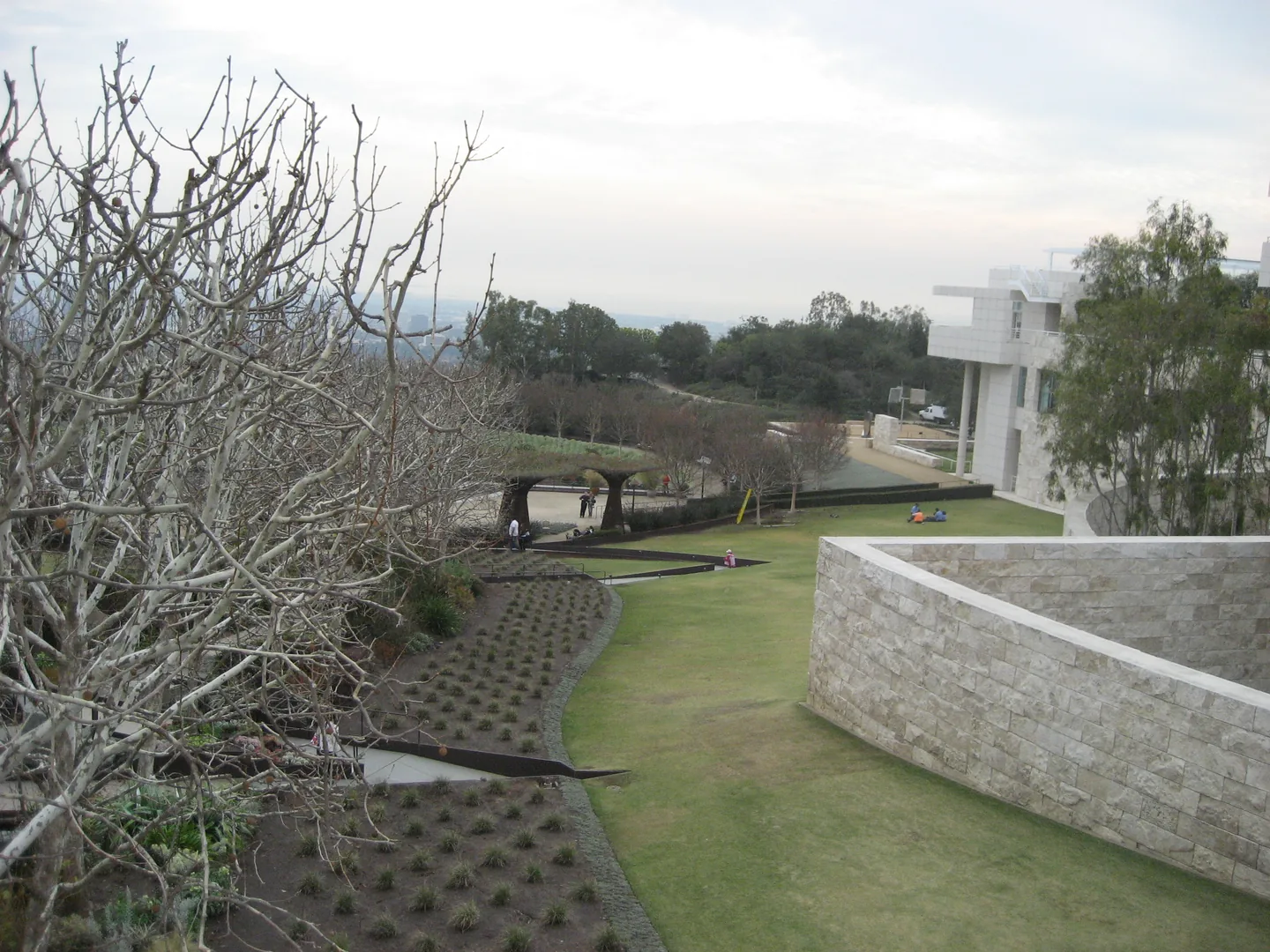

What the photograph shows
Art, architecture, and landscape on a Los Angeles hilltop.
The photograph looks across the Central Garden toward the Getty Center’s pale stone buildings. The campus rises above the Sepulveda Pass in the Santa Monica Mountains, where its elevated setting opens views toward the Pacific Ocean, the San Gabriel Mountains, and the street grid of Los Angeles. It is both a museum destination and a carefully composed meeting of buildings, gardens, research spaces, and landscape.
A campus shaped by light and stone
Architect Richard Meier designed the Getty Center, which opened to the public in December 1997 after years of planning and construction. A computer-operated tram carries visitors from the street-level arrival area to the hilltop campus. Getty’s official architecture guide explains that the complex is organized around a central plaza and combines a geometric grid with curves, terraces, and gardens.
Travertine gives the Center much of its visual character. Getty records that the project used 1.2 million square feet—about 16,000 tons—of the stone from Bagni di Tivoli, Italy. The split surfaces range from pale beige to honey in changing light, and some pieces reveal fossilized leaves, feathers, or branches. Glass walls, skylights, louvers, and shades bring controlled natural light into interior spaces while helping protect artworks.
Collections and research
The hilltop holds more than exhibition galleries. The J. Paul Getty Museum presents European paintings, drawings, illuminated manuscripts, sculpture, decorative arts, and photographs. Displays change, particularly for light-sensitive works on paper, so no single visit represents the entire collection. The Getty Research Institute occupies the circular building west of the Central Garden and supports scholarship through its library, archives, special collections, and exhibitions. Other buildings house the Getty Conservation Institute, Getty Foundation, and the Trust’s administrative work.
The Central Garden
California artist Robert Irwin created the 134,000-square-foot Central Garden as a work intended to change with time, weather, growth, and the visitor’s movement. A walkway crosses and follows a stream downhill toward a plaza. Water then passes over a stone waterfall into a pool containing an azalea maze. Bougainvillea-covered trellises, changing flower beds, and more than 500 varieties of plant material create shifting combinations of color, texture, sound, scent, reflection, and light.
The Central Garden is not the Center’s only outdoor space. Getty also identifies a cactus garden, sculpture gardens, and a sculpture terrace. These spaces soften the architectural grid and create pauses between galleries. The garden shown in the photograph is therefore not simply decoration around the museum; Getty treats it as part of the artistic experience.
Planning a visit
Admission to the Getty Center is free, but current entry, reservation, parking, transit, accessibility, and hours information should always be confirmed on the official Getty Center visitor page. Exhibitions, tours, and parts of the campus may change. Reviewing the official schedule before leaving is more reliable than depending on a saved listing.
Insurance connection: fine art and hillside property
A public museum’s insurance needs are different from a household’s, but the Getty’s collections provide a useful prompt for homeowners. The California Department of Insurance says fine art, antiques, and collectibles may be subject to special personal-property limits and may need separate scheduling or an endorsement. Its residential guide also advises homeowners to keep rebuilding limits current rather than assuming market value equals reconstruction cost. For a hillside home, wildfire mitigation and insurability remain property-specific—not something this landmark can predict. Use the Department’s residential insurance guide and Safer from Wildfires guidance to frame questions for a licensed professional. The issued policy controls.
Primary sources: Getty’s architecture guide, garden guide, museum collection, and architectural history.