Los Angeles city feature · 02
Griffith Observatory
A public observatory in Griffith Park where astronomy, architecture, and wide views of Los Angeles meet.
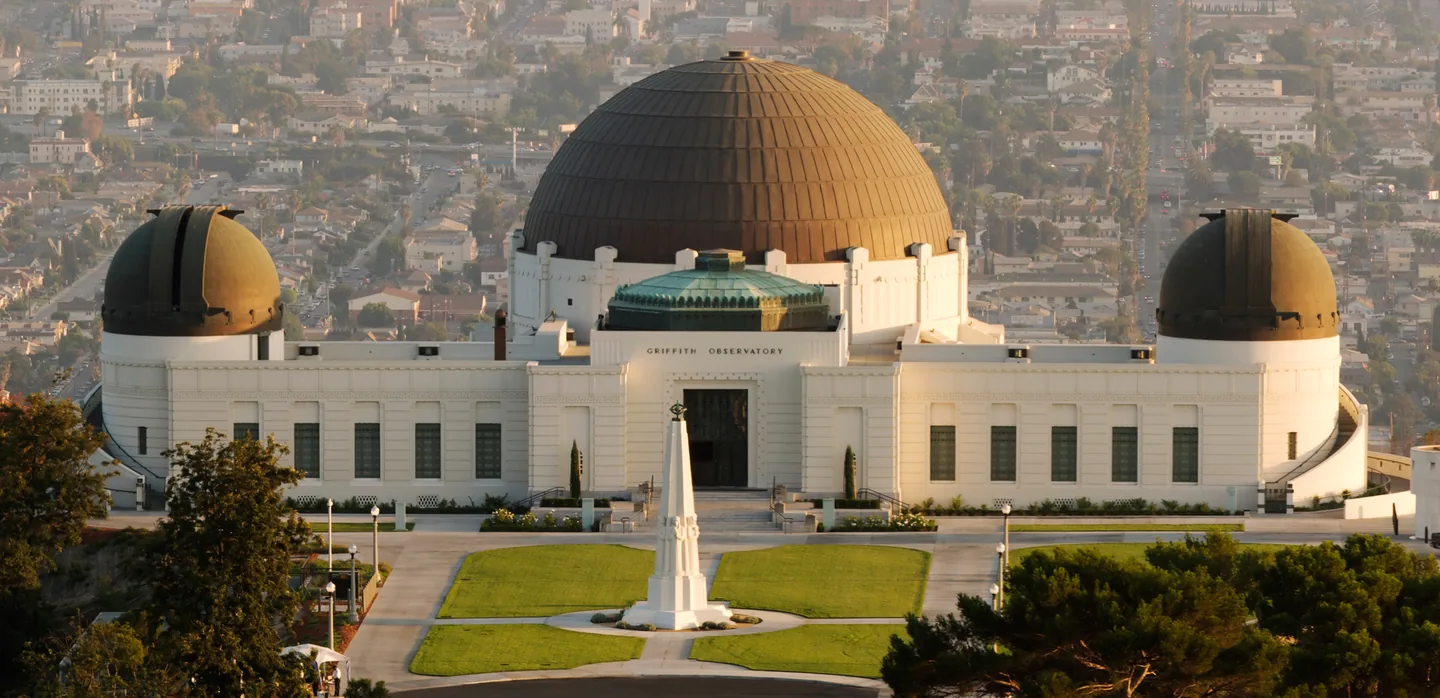

What the photograph shows
A public window onto the city and the sky.
The photograph shows Griffith Observatory’s white exterior and copper-clad domes above the Los Angeles Basin. The building occupies the south side of Mount Hollywood in Griffith Park. From its terraces, visitors can look outward toward the city, the Pacific on clear days, and the nearby Hollywood Sign; inside, the emphasis turns to observing Earth and the universe.
A public-science idea
Griffith Observatory grew from the vision of Griffith J. Griffith. In 1896 he donated 3,015 acres to Los Angeles for the public park that bears his name. His will later provided funds for an observatory and specified that people should be able to look through a telescope and gain a broader perspective. The official historical timeline dates the formal dedication to May 14, 1935, followed by the public opening on May 15.
The City of Los Angeles Department of Recreation and Parks has operated the facility since it opened. Admission to the building and grounds was intended to be free, making astronomy available beyond universities and research institutions. After decades of heavy public use, the building closed in 2002 for a comprehensive renovation and expansion and reopened in 2006. The renewed facility preserved the historic exterior while adding exhibition space below ground.
What visitors can observe
The original 12-inch Zeiss refracting telescope remains in the east dome. Griffith Observatory reports that more people have looked through it than through any other telescope in the world. When the building is open and skies permit, telescope demonstrators guide free nighttime viewing of objects such as the Moon, planets, and bright objects in the Milky Way. Solar telescopes provide daytime views of the Sun under supervised conditions.
Observation continues inside the galleries. A 240-pound bronze ball suspended from a 40-foot cable forms the historic Foucault Pendulum, which demonstrates Earth’s rotation. The Wilder Hall of the Eye contains a restored Tesla coil known for its visible electrical discharges. Live presentations in the Samuel Oschin Planetarium connect astronomical subjects with immersive projection and narration. Together, these elements make the observatory part telescope facility, part planetarium, and part science museum.
Planning a visit
The site can be reached by public transit, walking, cycling, shared ride, or car. Parking near the building is limited and typically paid during operating periods. The City specifically recommends the LADOT DASH Observatory/Los Feliz bus as a practical option. Building hours, telescope availability, planetarium tickets, road closures, and program schedules can change, so the official visitor page should be checked before traveling.
Insurance connection: understanding protection for the drive
A visit to Griffith Observatory does not change an auto policy, but planning a city drive is a practical reminder that common coverages do different jobs. The California Department of Insurance explains that liability coverage addresses injury or damage a driver causes to others, collision addresses contact with another vehicle or object, and comprehensive generally addresses non-collision events such as theft, fire, or vandalism. Deductibles, exclusions, drivers, and optional benefits vary by policy. Review the Department’s automobile insurance guide and the declarations and policy before relying on coverage. The issued policy controls.
Primary sources: City of Los Angeles observatory overview, institutional history, Zeiss telescope guide, and transportation guidance.